24 November 2026
← All writingHow a Hindu wedding is filmed in London: the rituals to plan for, why the pheras need more than one camera, recording the mantras, and filming by the light of the sacred fire.
Good Hindu wedding videography in London comes down to three things: more than one camera on the rituals that happen once, clean sound for the mantras, vows and speeches, and a plan for the light of the sacred fire and the hall around it. Share the running order from your pandit with your videographer before the day, so every camera is already in place for the jaimala, the kanyadaan, the pheras and the vidaai.
A Hindu ceremony is made for film. The mandap is decorated, the fire is lit, the pandit chants, and the couple walk slowly around the flames while the family watches from a few feet away. It looks calm. For a film crew it is hard work: the ceremony is long, the hall is often dim, and the moments that matter are quick and happen at close range.
Memory Filming has photographed and filmed Asian weddings in London since 2000. This guide covers what a Hindu wedding film should include, how the rituals are filmed, and what to ask your videographer. For the meaning and order of each ritual, see our Hindu wedding rituals guide.
What should a Hindu wedding film include?
A Hindu wedding film should hold the whole arc of the day: the preparations, the baraat and welcome, the rituals at the mandap, the farewell, and the celebration afterwards. The usual moments to plan for are:
- the haldi or pithi and the mehndi, if you are filming the days before
- the Ganesh puja
- the baraat and the welcome of the groom at the door
- the jaimala, the exchange of garlands
- the kanyadaan
- the pheras around the sacred fire and the saptapadi
- the sindoor and mangalsutra
- the vidaai
- the reception, speeches and first dance
Our Hindu wedding ceremony coverage page explains how we plan the ceremony day itself.
How are the pheras filmed?
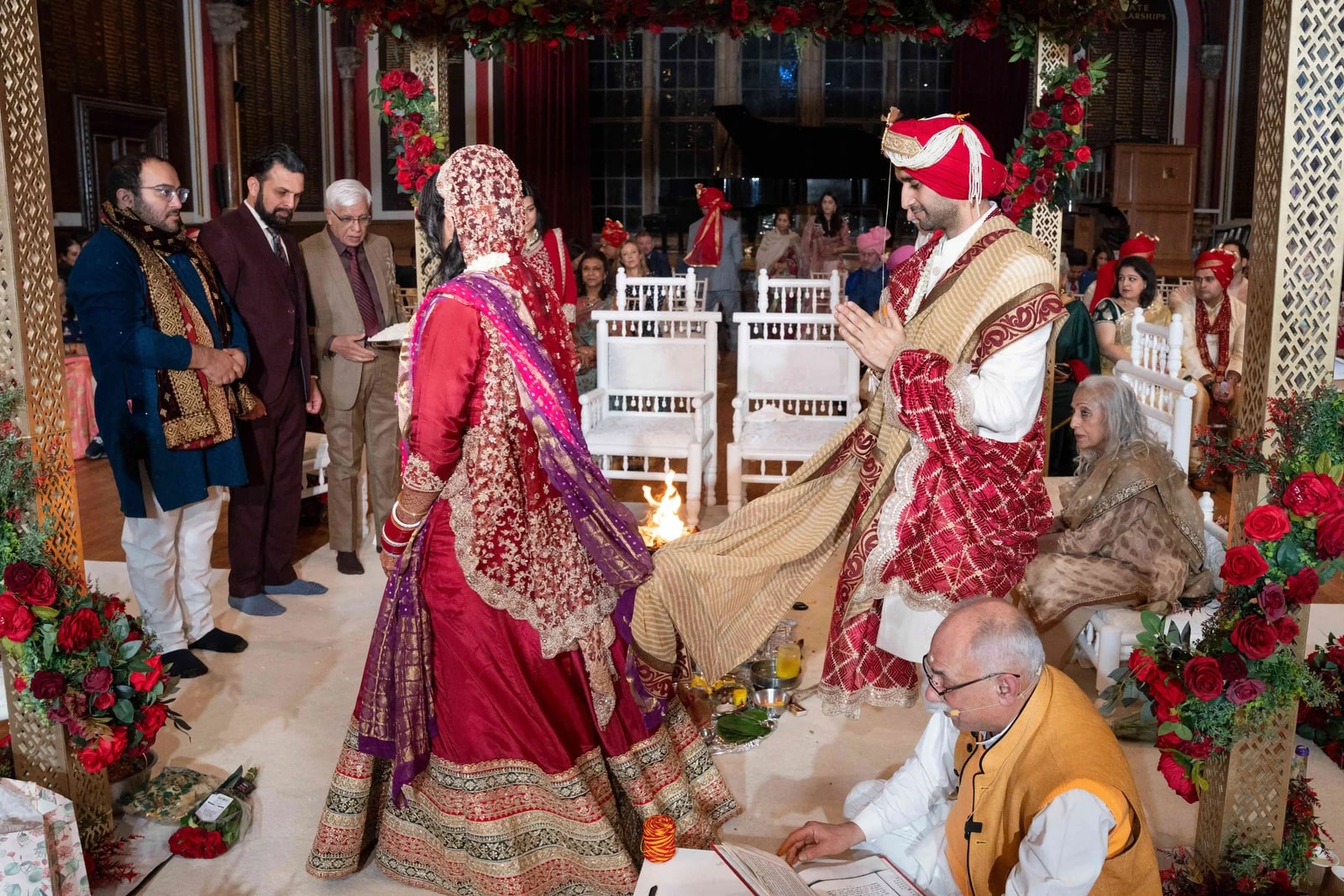
The pheras are the heart of most Hindu wedding films. The couple walk around the fire while the pandit guides each round, and in many North Indian weddings this is seven rounds. Many Gujarati weddings have four rounds followed by a separate saptapadi of seven steps, which the Wikipedia article on the saptapadi explains. Tell your videographer which form your ceremony follows, so the crew knows how many rounds to expect.
At the Hindu wedding of Tanuj and Tanisha, the seven rounds moving in a circle suited a slow, orbiting shot, and the crew held on individual reactions as each round closed rather than relying only on the wide view. At the wedding of Archi and Aditya at Grand Sapphire, each of the seven rounds was given its own space in the finished film.
Why does a Hindu wedding need more than one camera?
The kanyadaan, the pheras and the sindoor all happen once, close to the couple, while the family watches from the side. One camera can follow the couple or the family, but not both.
A second camera holds the wide view of the mandap and the guests while the lead follows the couple, so the editor can cut between the vows and the faces watching them. Our wedding videography page sets the rule: more than one camera on anything that only happens once, and backup bodies, batteries and audio in the bag. For a wedding with events over several days, the page lists two filmmakers, because parallel events cannot be covered by one.
How is sound recorded at a Hindu ceremony?
The mantras, the explanations from the pandit and the vows are what families most want to hear again, and a camera microphone at the back of the hall mostly records the room. A small wireless microphone on the pandit, and recorders close to the couple, keep the voices clear. Ask your videographer how the ceremony sound will be recorded, and tell the pandit in advance that a microphone may be clipped on.
How do you film around the sacred fire?
The fire is the brightest thing on the mandap, and the hall around it is often dim. A crew needs cameras that cope with low light and the experience to expose for faces rather than the flames, without bright lights that spoil the mood or break the rules of the venue. At the Hindu wedding of Sandeep and Shehroz at Dulwich College, the lighting was planned around the existing interior of the hall rather than relying on daylight through the windows.
Check the venue rules on fire and smoke before the day too. Many London venues limit open flame, and a havan may need approval.
Why plan camera positions before the day?
At the Syon Park wedding of Sonal and Pavan, the mandap was set up to make full use of the natural light of the venue, and the camera positions were planned in advance to hold both the wide shot of the ritual and the closer reactions as each of the seven rounds completed. Our Syon Park guide explains how the venue works for Asian weddings.
What does the edit look like?
Our videography page sets out the edit in stages: reviewing and logging the footage in the first week, a first assembly with licensed music, refinement of the pacing, colour and sound, a round of your notes, and delivery of the finished film around weeks five to six. For a single day with one filmmaker, the page lists an edited film of around 8 to 12 minutes. For a wedding across two to four days with two filmmakers, it lists around 15 to 20 minutes across all events. Ask whether you also want the full ceremony as a separate, longer film.
What should you tell your videographer before the day?
- The running order from your pandit, with timings.
- Whether your pheras follow the seven round or four round form.
- Who takes part in the kanyadaan and the other rituals, by name.
- The rules of the venue on fire, flash, drones and where cameras can stand.
- When the vidaai will happen. Our vidaai guide explains the options.
- Whether you want the full ceremony delivered as well as the highlights.
Questions couples ask
How long is a Hindu wedding film?
It depends on the package. Our videography page lists around 8 to 12 minutes for a single day, and around 15 to 20 minutes across all events for a multi day wedding. Many couples also ask for the full ceremony.
How many videographers does a Hindu wedding need?
One can cover a small, single venue wedding. For a large ceremony or events over several days, two filmmakers cover the couple and the family at the same time.
Can the pandit wear a microphone?
Usually, yes. Ask the pandit before the day, and agree where the microphone and any recorders will sit.
Can a drone be used at a Hindu wedding in London?
Only where the venue permits it. Many London venues and areas restrict drones, so check early.
How soon will we receive our wedding film?
Our videography page lists delivery around weeks five to six after the review, edit and your notes.
Should we book photography and video from one team?
It helps. One team agrees positions in advance and keeps out of its own shots at the mandap. See our page on photography and videography together.
Planning your Hindu wedding film?
Tell us your dates, your venue and your running order and we will reply within one working day with availability and an itemised quote.