15 October 2026
← All writingYou have probably seen the shot in a wedding film. The camera rises over a country house, drifts across the lawn and finds two small figures in a very large, very beautiful place. It is easy to see why drone wedding videography in the UK is one of the first extras couples ask about. What is less obvious is everything behind that one shot, from CAA rules to venue permission to the plain question of whether the sky will cooperate on the day.
Drone wedding videography in the UK is aerial filming of your wedding by a registered pilot with insurance, a CAA Flyer ID and Operator ID, and permission from the venue. It adds scale, movement and a sense of place to a cinematic wedding film, but only in the moments when it can fly safely away from guests.
This guide explains how aerial coverage works for a UK wedding, what the law asks of the pilot, where a drone suits a cinematic film and where it does not, and which questions to ask before you pay. We film Asian and multicultural weddings from our studio in Brentford, so we have also covered the parts most guides skip: processions, large marquees and the airspace around west London.
What does a drone add to a wedding film?
A drone adds distance. Ground cameras stay close to faces, hands and conversations, while a drone steps back and shows where it all happened.
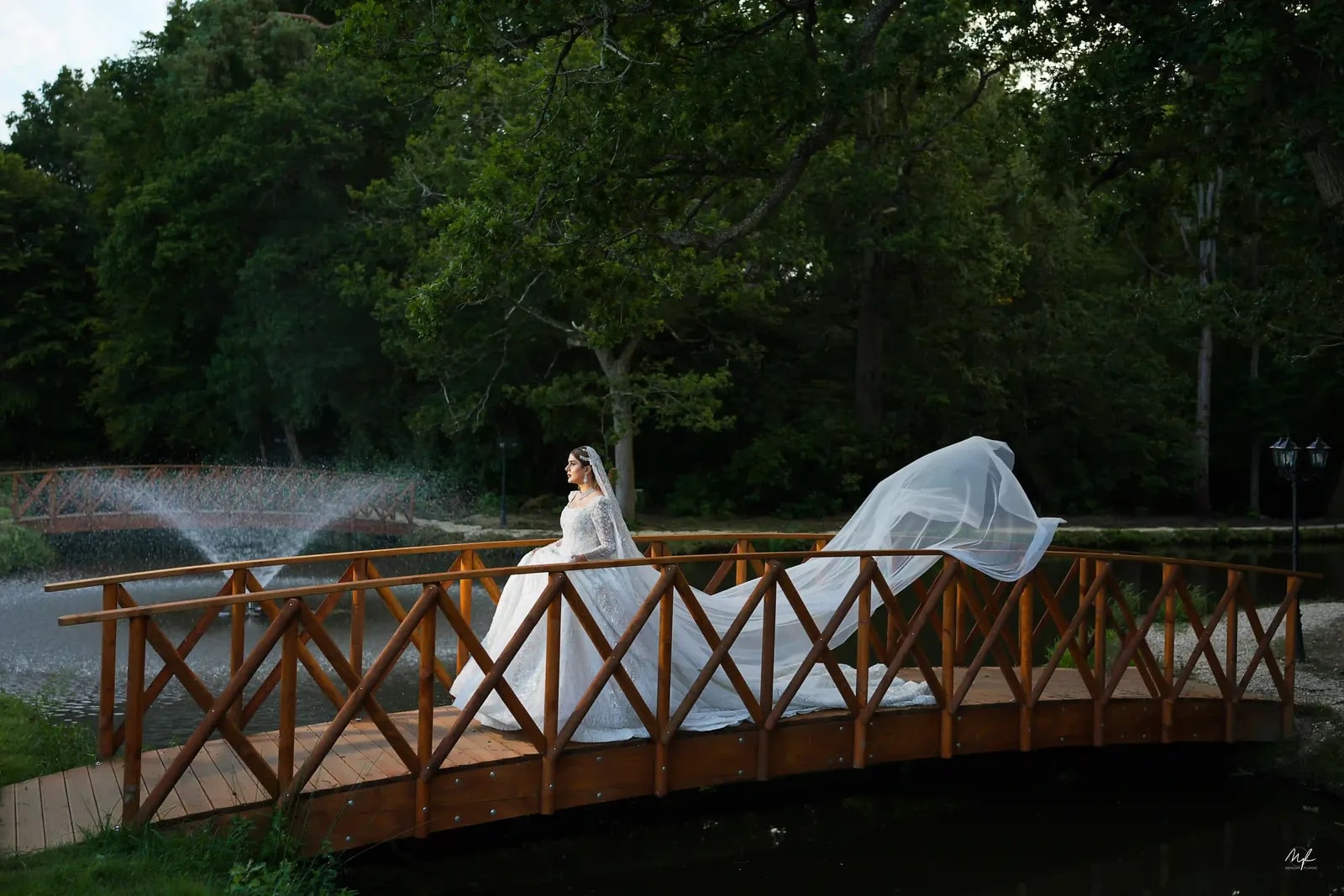
That contrast is what makes aerial footage useful in a cinematic film. The viewer feels the scale of the venue and then returns to the people with fresh attention. The shots that earn their place tend to be the opening reveal of the venue, a slow rise or pull back as the couple walk through the grounds, a car arriving along a driveway, and a wide view of a marquee glowing at dusk. A top down view of a garden or courtyard can also work as a quiet pause between two emotional scenes.
What a drone cannot do is replace the film. It cannot catch a father wiping his eyes during the vows or a grandmother laughing through the speeches. In most films we would expect aerial footage to take up a small share of the running time, placed where the story needs room to breathe.
Is it legal to fly a drone at a wedding in the UK?
Yes, provided the pilot is registered and follows CAA rules for the type of flight. The rules changed on 1 January 2026, so any guide that mentions only a PfCO is out of date.
From 1 January 2026, anyone flying a drone of 100g or more needs a Flyer ID, which comes from a free CAA theory test. A camera drone of 100g or more also needs an Operator ID registered to the person or company responsible for it. The old Permission for Commercial Operations, usually called a PfCO, has been replaced by the General Visual Line of Sight Certificate, known as a GVC, together with an Operational Authorisation from the CAA for flights in the Specific category. Newer drones also carry UK class marks from UK0 to UK6, and several of those classes must broadcast Remote ID.
Why does this matter at a wedding? The Open category keeps a drone at least 50 metres from uninvolved people. For heavier drones in the A3 subcategory it also means staying at least 150 metres from residential, commercial, industrial and recreational areas, which most wedding venues cannot meet. A pilot with an Operational Authorisation can work closer to buildings, but the 50 metre buffer from uninvolved people still applies, reducing to 30 metres only for take off and landing. Every flight stays below 120 metres, about 400 feet, and within the pilot line of sight. You can read the full rules on the CAA drone pages.
Your guests count as uninvolved people unless they have been briefed and know what the pilot is doing. That is why a careful pilot does not fly over a reception, a confetti line or a crowded procession, however good the shot would look. It is also why footage of the couple alone, during a planned portrait session, is the safest and often the most beautiful. Any pilot you hire should be able to explain how the plan for your day fits these rules.
Insurance is the other half. A pilot flying for payment needs commercial drone insurance, and many venues ask to see a copy before they agree.
Who has to say yes before the drone can take off?
The venue or landowner must agree to take off and landing, and if the venue sits inside a Flight Restriction Zone, air traffic control must also give permission.
Being allowed to fly through the air does not give a pilot the right to launch from your venue car park. The landowner decides that. Some venues, churches, gurdwaras and council owned parks refuse drones altogether or limit them to set hours. Ask your venue coordinator early, before the film is planned around a shot that cannot happen.
London adds another layer. The Flight Restriction Zone around Heathrow covers much of west London, and Hillingdon Council says about 74 percent of its airspace falls inside national no fly zones around Heathrow, RAF Northolt and Denham Aerodrome. Inside those zones it is illegal to fly any drone without approval. Heathrow asks pilots to apply for an off airfield permit through NATS at least 14 days before the flight. Our studio is in Brentford, so west London airspace is something we check as a matter of routine.
If your venue is near an airport, raise it at least a month ahead. A permit that arrives late is no use to anyone, and the film should never depend on one shot.
How does drone filming work at Asian and multicultural weddings?
Asian weddings are harder to film from the air than most because guest numbers are high, events run over several days, and the best moments, such as the baraat and the milni, happen in dense crowds.
A baraat is full of colour and movement, with dhol drummers, dancing relatives and a groom arriving with half the guest list. From the air it would look wonderful. It is also exactly the kind of gathering a drone must keep away from. Under the rules above, a pilot cannot hover over a crowd of uninvolved guests. What works is a wide approach shot from a safe distance as the procession comes along the drive, or a planned pass over family who have been briefed and have agreed. Your pilot should be able to tell you which of these is possible at your venue before the day, not on it.
Mehndi and reception marquees suit aerial work better. A marquee lit up at dusk with the lawn and grounds around it makes a strong opening for the evening part of the film. An outdoor ceremony on a lawn, a mandap in a garden or a nikkah at a country house can begin with a slow reveal from a distance and then hand over to the ground cameras for the ceremony itself.
At a Sikh wedding, the exterior arrival at the gurdwara can make a lovely opening, but gurdwaras and their car parks need permission like any other site, and the Anand Karaj inside is never a place for a drone. Where a venue is known for its grounds, as Syon Park is, the aerial shot often explains why the couple chose it. We cover the layout and lighting there in our Syon Park wedding photography guide.
Weddings abroad follow local drone law and not the CAA, so permission has to be checked country by country. Our destination weddings service explains how we plan for that.
Where should drone footage sit in a cinematic wedding film?
In a cinematic wedding film, drone footage works best as punctuation: it opens a scene, moves the story between places or gives the viewer a moment to breathe.
Cinematic films follow story structure, not the order of the day. A reveal of the venue at the start sets the place. A wide rise after the ceremony gives the film a pause before the next emotional scene. A pull back at the end of the portraits can close a chapter. Used that way, a handful of clips does more than a dozen scattered through the edit.
Technique matters as much as placement. If the drone clip looks sharper, more digital or brighter than the ground footage, the viewer notices the join. Pilots who film for cinema use ND filters so the shutter speed stays right for natural motion blur at 24 frames per second, shoot in 4K and match the colour grade to the ground cameras. Ask to see a film where aerial and ground footage sit together, not a separate drone reel.
Some pilots can also shoot true vertical video, which suits a short clip for relatives who could not travel. It needs setting up on the day, so ask about it early.
How do we fit the aerial window into your wedding day?
A drone needs a planned window, often around 15 minutes, agreed with the photographer, planner and venue before the day.
The best window is usually golden hour or the quiet stretch between the ceremony and the reception, when the couple are already taking portraits away from the guests. In that window the couple are involved people, the guests are elsewhere and the light is on your side. A photographer will not want a drone in the sky while framing a quiet portrait, and the couple will not want the noise either, so the pilot and photographer should agree who has the space and when.
Keep the drone out of the ceremony and out of the speeches. The sound is small outdoors, but it is not the sound anyone wants under vows or a prayer. A good pilot lands well before anything important begins and does not need reminding.
Reserve a second window if the schedule allows. Wind, rain and low cloud can ground a drone for an hour and then pass.
What happens if the weather says no?
If wind, rain or low cloud stops a drone flying safely, the pilot should not fly, and the film should still work without the aerial footage.
Pilots make this call on site, using the limits of the aircraft and the conditions in front of them. A pilot who flies in unsafe weather to save a shot is risking the drone, the guests and the venue relationship. Ask before booking what happens if the drone cannot fly: whether the price is reduced, whether there is a credit, or whether a second attempt is possible at another time that day. Ask also how the edit will cover the gap. A film built on ground cameras, with the drone as a bonus, does not suffer.
How much does drone wedding videography cost in the UK?
Aerial coverage in the UK is priced in three ways: included in a wedding film package, added as an extra, or hired from a licensed pilot by the hour, and the figures differ a lot between them.
Bridebook puts typical UK wedding videographer prices between £500 and £2,500, with an average of £1,514, and London and the South East usually cost more. Within that, some suppliers list aerial coverage from about £300 for a short flight, while one London studio lists a licensed pilot at £599 for the first hour. The gap comes from what sits behind the price: pilot qualifications, insurance, the time spent on permissions and risk assessment, travel, and the hours of editing and grading needed to match the clips to the rest of the film.
A low quote is not automatically a bad one, but it should prompt questions. A very cheap flight may mean no commercial insurance, no Operational Authorisation or no plan for a venue in restricted airspace. Compare the paperwork before you compare the prices.
Questions to ask a drone wedding videographer before you book
Bring these to every call.
- Do you hold a CAA Operator ID and a Flyer ID, and can I see them?
- Which qualification and authorisation do you hold, such as a GVC and an Operational Authorisation?
- Can I see your commercial drone insurance certificate?
- Have you flown at my venue or one like it, and what did the venue say?
- Is my venue inside a Flight Restriction Zone, and who applies for permission?
- What will you do if the weather stops you flying?
- Where in the film do you expect the aerial footage to sit?
- Is the drone flown by your own team or by a pilot you bring in?
Questions couples ask us about drones
Do I need drone footage in my wedding film?
No. Many strong cinematic films have none. A drone helps most when the venue has grounds or a landscape worth seeing. In a city hotel or small hall, ground cameras usually serve the story better.
Can a drone fly over wedding guests?
Not safely, and not within the rules unless guests have been briefed. Guests who are unaware of the plan count as uninvolved people, so pilots keep at least 50 metres away and avoid flying over a gathering.
Do wedding drone pilots need a licence in the UK?
There is no single drone licence, but a pilot flying for payment needs a CAA Operator ID, a Flyer ID and commercial insurance. Many also hold a GVC and an Operational Authorisation, which replaced the old PfCO.
How far ahead should drone permission be arranged?
As early as you can. A permit in a Flight Restriction Zone such as Heathrow needs at least 14 days, and venue permission can take longer, so raise it when you book your videographer.
Is a drone loud at a ceremony?
It is noticeable up close and quiet from a distance. Good pilots keep the drone away from the ceremony, speeches and prayers, and fly during portraits or before guests arrive.
Are drones allowed at every wedding venue?
No. Some venues ban them or limit them to set times, and some sit inside restricted airspace. Ask the venue before you book anything.
Planning aerial coverage for your wedding
If you are planning a wedding in London or elsewhere in the UK and want to know whether aerial footage suits your venue, send us the venue and date through our wedding videography in London page. We will tell you honestly whether a drone would add to the film and what the permission work is likely to involve.