2 October 2026
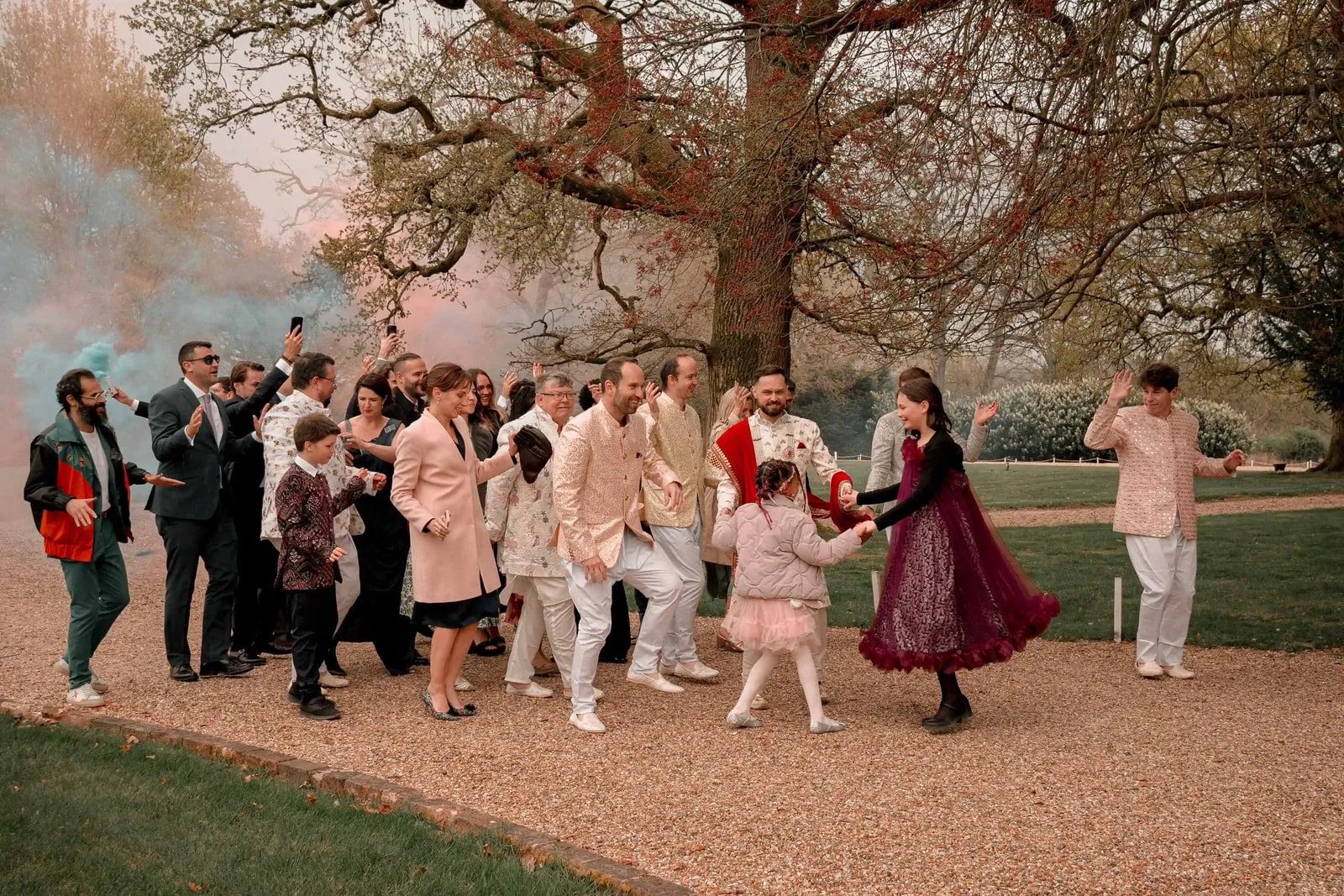
← All writingThe Baraat is the groom's wedding procession, the arrival of the groom with his families and friends, who arrive with music, dancing and a dhol player, at the ceremony venue. It is featured in weddings of the Hindu, Sikh and Muslim community and is one of the most audible and visually appealing events of the day.
What is a Baraat?
A Baraat is the groom's wedding procession, the time when the groom arrives at the marriage place along with his family, friends and a dhol player, who invariably play the dhol throughout the entire way.
The word Baraat itself means a marriage procession. It is played a significant part in Hindu and Sikh weddings, and also is essential in Muslim and Pakistani weddings, typically with the following Nikkah service. In all religions it marks the same moment. The groom has come and the wedding is truly beginning.
The groom used to come in a horse to the place, which is said to have been their tradition when they were travelling far from the bride's family. The tradition of the horse has not been forgotten in the modern era; although most Baraats in the UK that use the tradition are now a more celebratory way of entering rather than literally travelling. For Muslim and Pakistani weddings, our Nikkah photography guide and Pakistani wedding videography guide cover what follows, through to the Walima reception.
How does a Baraat differ between Hindu, Sikh and Muslim weddings?
The principle stays the same in all religions. A loud, joyful procession bringing the groom to the venue, but the ceremony it leads into and the traditions around it change.
In Hindu and Sikh wedding ceremonies, the Baraat comes after Milni (the formal gathering of both families) and precedes the main ceremony which takes place under the Mandap. In Muslim or Pakistani wedding ceremonies, the Baraat is followed by the Nikkah, the Islamic marriage contract and before the groom enters the house, families hold a playful ritual known as Rasta Rukai. We'll go into that both ways below.
What happens during the Milni?
Milni means meeting. The time just after the groom's procession arrives at the site where the families will meet, typically with garlands and gifts and warm hugs.
The relatives of the bride come out to greet the groom and his family, exchanging garlands and small gifts at the wedding itself, which is the proper time for the first time meeting. Sometimes it's amusing as well. Sometimes there's a friendly competition for the height, as men carry each other up and as women carry each other up, and some of the best unscripted photos of the day are shot.
What is the difference between Joota Chupai and Rasta Rukai?
They are both forms of the playful tradition, Hinduism and Islam, in which the bride's side people withhold something from the groom until he makes a small repayment or agreement.
At Hindu and Sikh weddings, when the groom removes his shoes as he walks into the ceremony area, the bride's younger relatives attempt to take the shoes from him, and the groom's side attempts to keep the shoes. It typically concludes in friendly negotiation, commonly in cash, prior to shoes being turned back home.
The Muslim and Pakistani version is called Rasta Rukai. The bride's family keep the bridegroom away from the wedding hall and demand money to let him in. The warmth and teasing of both traditions is the same and it yields some of the funniest and most relaxed photos of the day because no one is posing and everyone is laughing.
How do grooms arrive at a Baraat in the UK today?
Although some UK Baraats today still use horses (where venues allow) the majority of couples opt for decorated cars for their entrance, and a few opt for something more unique for an unforgettable entrance.
We've also captured images of grooms in classic cars, motorcycles and even a helicopter for one special occasion, which was a wedding. Smoke bombs are also popular, and are carried by the groom's relatives or guests to color and energize the bride and groom as they arrive.
The dhol player will typically precede the groom in all but appearance and with his music establish the rhythm for the other dancers following.
Also worth Reading to check our guide on Documentary wedding phototgraphy London.
How should photography and videography be planned for a Baraat?
A Baraat is a fast process and takes place in a crowd, thus the most important aspect of the Baraat is that you have the coverage to capture both sides of the moment in one go.
Wherever possible we recommend a second photographer. With one of us in the vicinity of the groom and the rest of the group, the other one may get the shots of the bride's family waiting to welcome everyone, which could be difficult to capture at all with just one shooter. The shots are close and always changing, so we use wide lenses instead of a long zoom and we don't shoot from one place but move around the procession.
It is a busy, loud event that has all sorts of people running around and a bit of smoke thrown and sometimes a horse, so we take care to protect our gear and avoid being in the way of the videographer and other photographers, when possible. The aim is to be honest and journalistic, not to have the images set up. Never ask anyone to stop dancing to pose for a picture.
What happens after the Baraat?
Once the procession and the Milni completed the day becomes the main ceremony. The Mandap for Hindu and Sikh weddings, or the Nikkah for Muslim weddings.
For Hindu weddings, our Hindu wedding rituals guide covers everything from here through to the Vidaai farewell. For Sikh weddings, our Anand Karaj guide picks up from this point.
Baraat Ceremony Phototgraphy: Frequently Asked Questions
What does Baraat mean?
Baraat means marriage procession. It is used to describe the time when the man arrives with his relatives and friends to the wedding place, typically with music and dancing.
Is the Baraat only a Hindu tradition?
No. It plays a key role in Hindu and Sikh weddings, and is also used in Muslim and Pakistani weddings, where it is used to introduce the Nikkah ceremony, and not the Mandap ceremony.
Do we need a horse for our Baraat?
No. It is traditional to arrive at the venue by a horse in a bared entry, but most UK Baraats reach the venue by decorated car or by another chosen route of the couple. We can photograph whichever you choose.
What is the Milni and does every wedding have one?
The formal meeting of both the families is called “milni”, and takes place immediately after the Baraat, where garlands and gifts are exchanged. It is also popular at Hindu and Sikh weddings although some families may choose a shorter version, or one as part of the welcome at the wedding venue.
How many photographers do we need for a Baraat?
As much as possible, two, one with the groom's side and one with the bride's family, both in different locations at the same time.
How long does a Baraat usually last?
Normally, most of the run is between twenty and forty five minutes from the beginning of the procession till the Milni, but can be longer for bigger Baraats with more people.
Can you photograph a Baraat and the ceremony that follows as one booking?
Yes, this is the way we usually do it. The Baraat is directly released into Milni and then the main ceremony so continuous coverage throughout the sequence is best.
If your wedding week involves a Baraat, please make sure to contact your date and venue and we will plan coverage around the entire Baraat, Milni, and of course everything else that comes after it!
Related Pages and Guides
- Our Pagri and Sehra Bandi photography guide
- Our Mehndi Night photography and videography guide
- Sikh wedding photographer London
- Hindu wedding photographer London
- Sikh wedding ceremony coverage
- Our drone wedding videography guide