20 November 2026
← All writingThe order of a UK Asian wedding, from dholki and mehndi to the nikkah, baraat, rukhsati and walima, with how far apart to hold each event and a sample weekend.
An Asian wedding timeline in the UK usually covers dholki evenings and a mayun in the weeks and days before the wedding, a mehndi one or two nights before, the nikkah and baraat on the wedding day with the rukhsati at the end of it, and a walima hosted by the family of the groom a day or more later. Most families now fit the main events into one long weekend.
Knowing the order is the easy part. The decisions that shape the weekend are about spacing: how many nights sit between the mehndi and the baraat, whether the nikkah happens on the wedding day or weeks earlier, and how much rest everyone gets before the walima. This guide follows a Pakistani and wider Muslim wedding, because that is the sequence most UK couples ask us about, and every family adapts it in its own way.
What order do the events of an Asian wedding go in?
In most UK Pakistani and Muslim families, the order is:
- Dholki evenings
- Mayun, sometimes called the ubtan
- Mehndi
- Nikkah, the marriage contract
- Baraat, with the main wedding reception
- Rukhsati, the farewell of the bride
- Walima
Some families add an engagement, the mangni, months earlier, and some skip the mayun. The nikkah moves around more than any other event, as you will see below. Sikh, Hindu and Bengali weddings follow a different sequence but raise the same planning questions, and our ceremonies guide covers each tradition.
The events one by one
Dholki
Dholki evenings are informal gatherings at the family home, with singing to the dholak, a small hand drum, and plenty of food. They can start weeks before the wedding and often run over several evenings. They need very little planning, which is a large part of their charm.
Mayun and ubtan
The mayun usually comes a few days before the mehndi. The bride wears simple yellow, and the women of the family rub ubtan, a paste of turmeric and gram flour, onto her face and hands. In some families the bride then stays at home until the wedding, and some hold a version for the groom as well. It is a small event for close family.
Mehndi
The mehndi is the henna night and, in many families, the loudest night of the whole wedding. The hands and feet of the bride are decorated with henna while the families sing, dance and tease each other across the room. Some families hold one joint mehndi in a hall; others hold a separate night for each side.
Plan the mehndi for at least one night before the wedding, and ideally two. Henna darkens over the following day or so, and a mehndi on the night before the baraat costs the bride most of her sleep before the biggest day. Our mehndi night photography and videography guide goes into timings for the night itself.
Nikkah
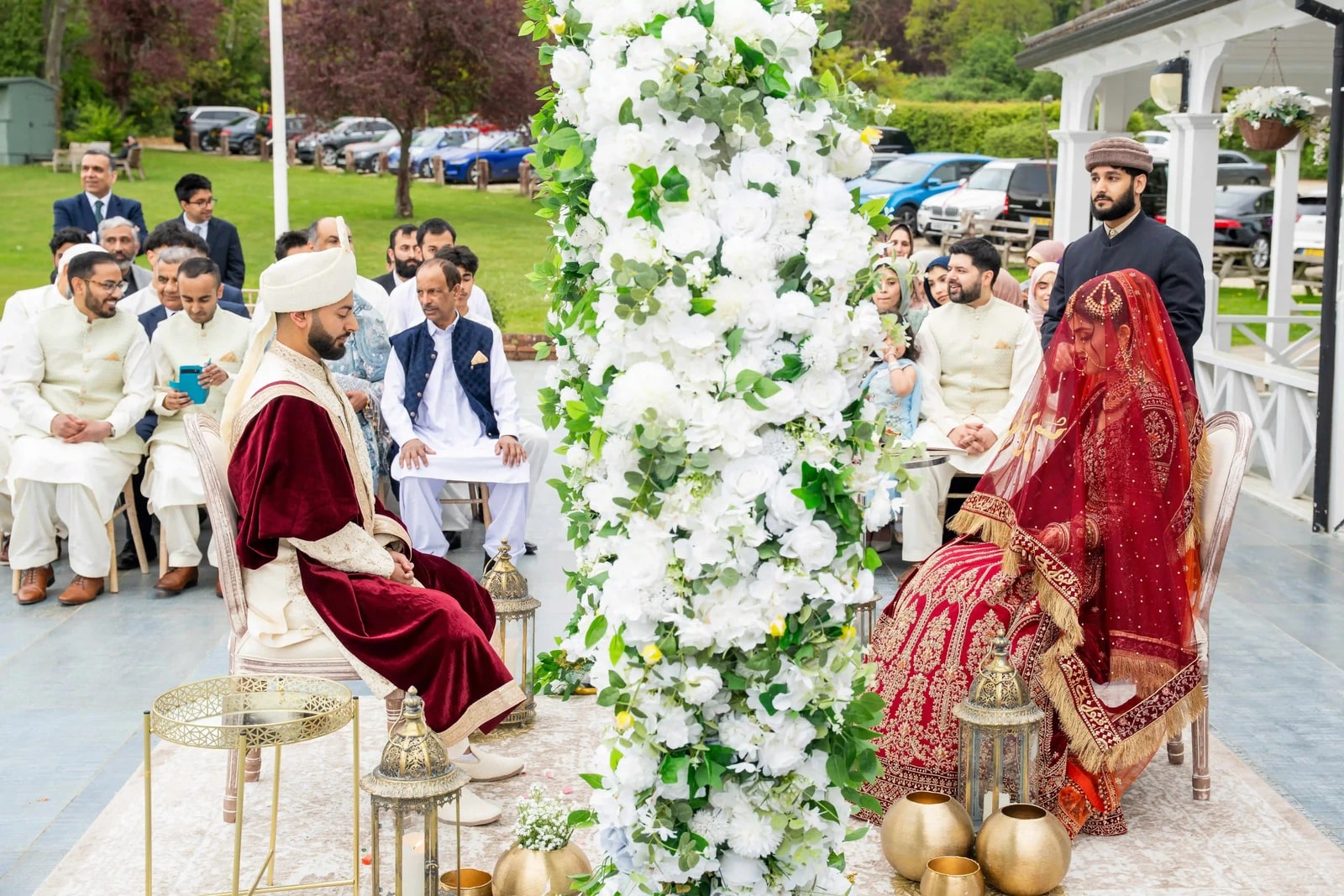
The nikkah is the Islamic marriage contract. An imam or officiant leads it, the bride and groom each give their consent, the mahr is agreed, and witnesses sign. The ceremony itself is usually short. Families tend to hold it in one of three ways: at a mosque or at home days or weeks before the reception, at the wedding venue just before the baraat, or on the same day as the walima. Our Muslim wedding ceremony page explains each part of the nikkah.
In England and Wales, a nikkah on its own is not usually recognised as a legal marriage. Unless it takes place in a building registered for marriages with the right person present, couples need a civil ceremony as well, and that means giving notice at the register office in advance. The rules are on the GOV.UK marriages page. Many couples hold the civil ceremony on a quiet weekday before the wedding weekend so that it does not crowd the main days.
Baraat
The baraat is the arrival of the groom with his family and friends, usually to the dhol, at a reception that the family of the bride usually hosts. Then come the welcome at the door, the couple on the stage, family photographs, dinner and, in many families, the joota chupai, where the sisters of the bride hide the shoes of the groom and bargain for their return.
Rukhsati
The rukhsati is the farewell of the bride as she leaves her family with her husband at the end of the baraat day. In many families a Quran is held over her head as she walks out. It is often the most emotional few minutes of the whole wedding, and it falls at an awkward time: late at night, with tired guests and a venue that wants its hall back. Give it a fixed time in the running order and make sure the car is ready.
Walima
The walima is the reception hosted by the family of the groom after the marriage. It is a Sunnah, and in many families it is as large as the baraat, sometimes larger. The day after the baraat is the most common choice in the UK, though some families wait a few days or weeks for a hall, and some hold it on the same day as the nikkah. If your family follows particular religious guidance on timing, ask your imam. Our walima photography guide covers what usually happens on the day.
How many days does an Asian wedding take?
Most UK Asian weddings have three main days: the mehndi, the wedding day with the nikkah and baraat, and the walima. Add dholki evenings, a mayun and a separate civil ceremony and the whole run can stretch across several weeks, but guests who travel usually see one long weekend. Families tend to settle on one of three shapes.
One long weekend
Mehndi on Thursday or Friday, nikkah and baraat on Saturday, walima on Sunday. Guests travelling from Birmingham, Manchester or abroad make one trip, and the momentum carries everyone through. The price is energy, since by Sunday the couple has had three late nights in a row.
Two weekends
The nikkah and mehndi on the first weekend, the baraat and walima on the second. Families get breathing space and time to fix anything that went wrong, at the cost of two rounds of hall bookings, outfits and travel.
Fewer, combined days
Some couples hold the nikkah and walima on one day at a single venue. Safa and Usman did this: their film follows the nikkah, the celebration straight after it, and a walima that carried on into the evening.
A sample weekend, day by day
Treat this as one example rather than a template. Your venues, your families and the time of year will all change it.
Thursday: the mehndi for the bride, at home or in a banqueting hall, from early evening until late.
Friday: a rest day for the bride. If the groom has his own mehndi, this is the night for it, kept smaller.
Saturday: getting ready from late morning, the nikkah at the venue in the afternoon, then the arrival of the baraat, the stage, family photographs and dinner, with the rukhsati at the end of the night.
Sunday: a slow morning, then the walima in the evening, hosted by the family of the groom.
Where the weekend usually goes wrong
Most problems in a wedding that runs over several days come from the gaps between events rather than the events themselves.
Underestimating travel
If the mehndi is in one town, the nikkah at a mosque and the baraat at a hall across London, every move takes longer than the map says. Allow time for traffic, parking and the photographs that always seem to happen on the pavement.
Forgetting to eat
Brides in particular can go from getting ready to the end of the baraat without a proper meal. Ask one person to make sure the couple eats, and keep a plate aside for them.
Ignoring the light
In December the sun sets before four in the afternoon in London, while in June it is still light after nine. If you want outdoor portraits on the wedding day, the season decides when they can happen.
Rushing the rukhsati
Because it comes last, it gets squeezed. Decide in advance where it happens and who walks out with the bride.
Working from different running orders
Each family often has its own idea of the timings. One shared document with addresses and start times for every event saves a great many phone calls on the day.
Planning your photography and film across the days
A wedding over several days asks more of your photographer and videographer than a single day does. Book the whole run with one team if you can, so your photographs match from one event to the next and you end up with one film that tells the story from the first dholki to the end of the walima. Send the team the running order for every day, point out the relatives who matter most, and give the nikkah, the arrival of the baraat and the rukhsati fixed times.
Memory Filming was founded by Khurram Iftikhar in 2000 and has filmed about 9,700 weddings since, including about 3,300 Asian ceremonies.
Questions couples ask
How many days does a Pakistani wedding last?
In the UK, most Pakistani weddings have three main days: mehndi, baraat and walima. With dholki evenings, a mayun and a separate civil ceremony, the full run can last a few weeks, although the main events usually fall in one long weekend.
Does the walima have to be the day after the wedding?
No. The day after the baraat is the most common choice, but many families hold the walima a few days or weeks later, depending on hall availability, and some hold it on the same day as the nikkah. If timing matters to you for religious reasons, ask your imam.
Is the nikkah on the same day as the baraat?
It can be. Many UK families hold the nikkah at the venue just before the baraat reception. Others hold it earlier at a mosque or at home, sometimes weeks before, so that the wedding day itself is purely a celebration.
Is a nikkah legally binding in the UK?
Not on its own in most cases. In England and Wales a religious ceremony only counts as a legal marriage if it meets the rules on where it is held and who is present, so most couples also hold a civil ceremony. Check the current requirements on GOV.UK and with your local register office.
How long before the wedding should the mehndi be?
One or two nights before the baraat works best. That gives the henna time to darken and gives the bride at least one proper night of sleep before the wedding day.
Who hosts the baraat and the walima?
Traditionally the family of the bride hosts the baraat and the family of the groom hosts the walima. Many families now share the costs differently, so agree it early, before any halls are booked.
Check your dates with us
If you are planning a wedding over several days, tell us your dates and your events and we will let you know whether we are free and how we would cover each day.
Related pages and guides
- Mehndi night photography and videography guide
- What a walima photographer captures
- Nikkah photography: capturing a Muslim ceremony respectfully
- Pakistani wedding videography: mehndi, baraat and rukhsati
- Baraat ceremony photography
- The 18 month Asian wedding photography timeline
- Muslim wedding venues in London
- Muslim weddings