25 November 2026
← All writingHow to design an Asian wedding stage that photographs well: lighting faces, backdrop depth and colour, room for family groups, where the stage sits, and effects.
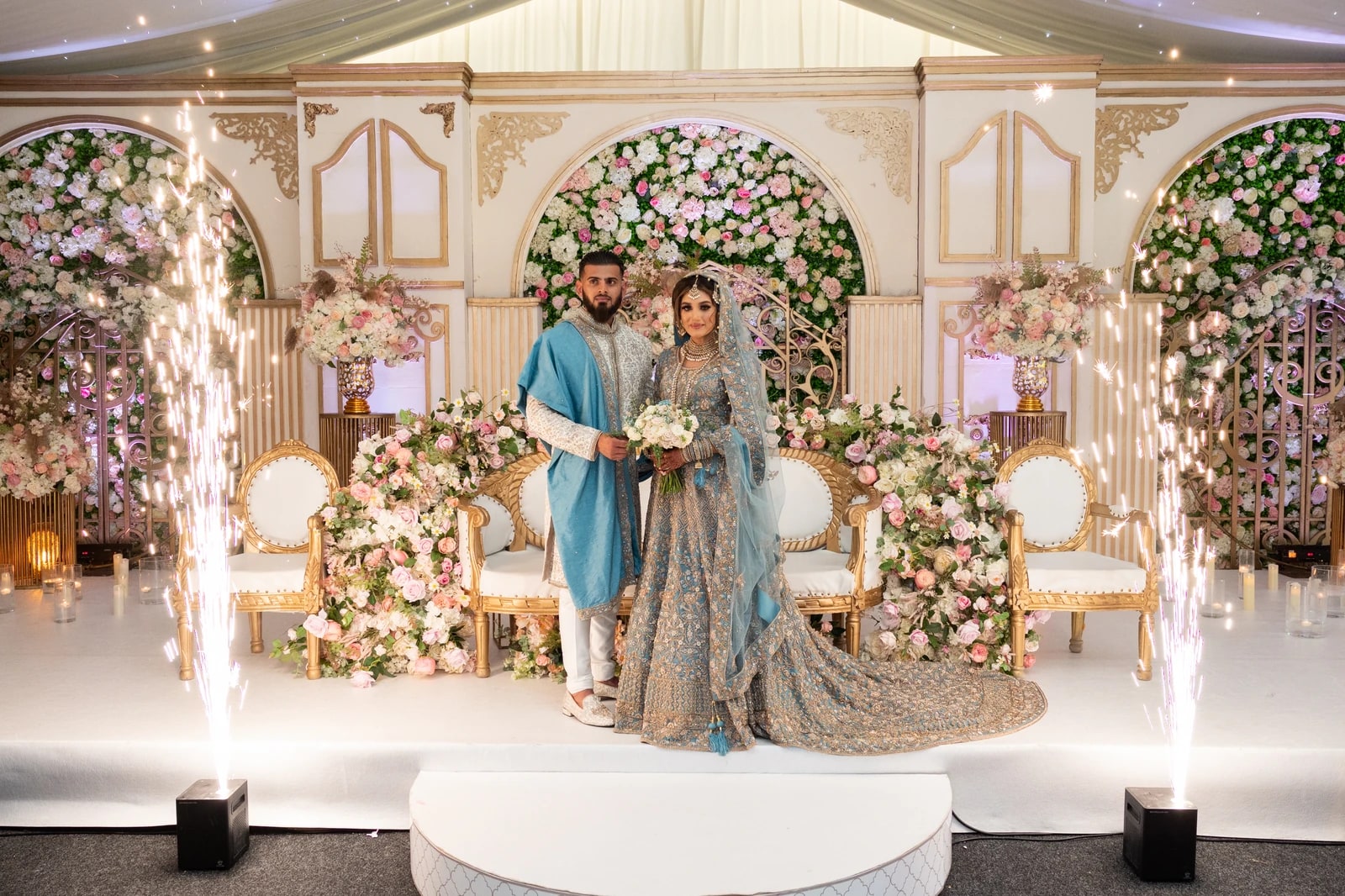
An Asian wedding stage looks good in photos when the couple is lit from the front, the backdrop sits far enough behind them to have depth, there is room on either side for family groups, and nothing on the stage competes with faces and outfits. Before you sign off the design with your decorator, share it with your photographer and videographer, because small changes to lighting, depth and layout make a large difference to the pictures.
Walk into almost any Asian wedding reception in London and the stage is the centre of the room. It is where the couple sits after the entrance, where the families come up one group after another, and where many of the reception photographs are taken. A stage can be beautiful in the room and still photograph badly, usually for reasons nobody thought about when it was designed.
Memory Filming has photographed and filmed Asian weddings in London since 2000. This guide looks at the stage from behind the camera: what helps, what gets in the way, and what to agree with your decorator and venue before the day.
Why does the stage matter so much in wedding photos?
At a reception, the stage is where the couple spends most of the evening, so it appears in more photographs than almost any other part of the day. The entrance ends there, the family photographs happen there, and at a walima or a reception the couple often sits there between dinner and the dancing.
That means every choice on the stage shows up again and again: the colour of the backdrop behind every family group, the height of the sofa in every seated portrait, the lighting on every face. Our guide to Asian banqueting halls in London covers choosing the room. This guide covers what goes on the stage inside it.
How should a stage be lit for photography?
Most stage lighting is designed to show off the flowers and the backdrop, not the people standing in front of them. The result can look striking in the room and leave the couple with dark faces, or faces tinted by coloured uplighters.
When you speak to your decorator or production company, ask for:
- soft, even light on the front of the stage, where the couple sits and the families stand
- coloured lighting kept to the backdrop, not pointed at faces
- no bright lights directly behind the couple, which turn them into silhouettes
- a plan for the room after dark, when the house lights go down for dancing
It takes planning. At the Hindu wedding of Tanuj and Tanisha, the mandap sat inside one of the function spaces, so we planned around the interior lighting in advance rather than adjusting on the day. At the wedding of Sandeep and Shehroz, the lighting was planned around the existing interior of the hall. The same thinking applies to a reception stage.
What makes a stage backdrop photograph well?
The backdrop should frame the couple, not compete with them.
Start with depth. Leave space between the sofa and the backdrop. When the couple sits right against it, the picture looks flat and the flowers seem to grow out of their heads. A gap lets the backdrop fall slightly softer behind them.
Then think about the outfits. A deep red lehenga in front of a deep red backdrop can disappear, and a pale outfit can wash out against white flowers. Tell your decorator what the couple and the families will wear.
Mirrored panels and glossy surfaces reflect flash and lights, and can show the photographer in the background. LED screens can also flicker on video, so ask your videographer before choosing one.
Finally, clutter. Speakers, cables, water bottles and spare chairs end up in every photograph. Agree where they will go before guests arrive.
How big should the stage be for family photos?
Family photographs at an Asian wedding are often large groups, with parents, grandparents, siblings, aunts, uncles and cousins coming up together. A stage that only fits the sofa forces people to squeeze in or stand on the steps.
Allow room on either side of the couple for a group to stand comfortably, and make the steps wide and shallow enough for older relatives to climb easily. A clear space in front of the stage also matters, because the photographer needs to step back far enough to fit everyone in. Our Asian wedding family photo list helps you plan the order, so the groups move on and off the stage quickly.
Where should the stage sit in the room?
Ask the venue where the stage will go before the floor plan is fixed. A few points help:
- keep a clear path from the entrance to the stage, because the entrance of the couple is one of the moments that happens once
- avoid placing tables tight against the front of the stage, where they block the view
- avoid windows behind the stage if part of the event is in daylight, because they turn faces dark
- leave room for the photographer and videographer to move along the front without walking through guests
At the walima of Mehreen and Hasnat, the entrances were protected in the schedule rather than rushed. At the wedding of Maliha and Hassan, the coverage opened up with wider lenses as the room filled and the couple made their entrance. A clear route and a stage that can be seen from the floor make both easier.
What about sparklers, smoke and other effects?
Cold spark fountains, low smoke and confetti cannons can look dramatic, but they only last seconds. Agree the timing with your photographer and videographer, so the cameras are in place when the effect starts, not after. Check the rules with the venue too, because many London venues restrict effects, and some do not allow certain effects at all.
Questions couples ask
What is the most common stage mistake in photos?
Lighting the flowers but not the faces. A beautiful backdrop with a dark couple in front of it is the problem we see most. Ask for soft front light on the couple.
Should the stage be the same at the mehndi and the reception?
Not necessarily. A mehndi stage is often lower and more relaxed, with seating close to the floor. A reception stage is usually more formal. Plan each one for how the couple will use it.
How far should the sofa be from the backdrop?
Far enough that the couple is not pressed against it. A little space gives the picture depth and keeps the backdrop from looking flat behind them.
Can we use a mirrored or LED backdrop?
You can, but check with your photographer and videographer first. Mirrors reflect light and the crew, and LED screens can flicker on film.
Who should we share the stage design with?
Your decorator, your venue and your photographer and videographer, ideally together. One conversation before the day saves a lot of compromise on it.
Do you need two photographers for the stage?
For a large reception, it helps. One can stay with the couple on stage while the other covers the guests and the room. Our wedding photography page sets out how coverage is shaped.
Planning your stage and your coverage?
Tell us your date, your venue and your events and we will reply within one working day with availability and an itemised quote. Send us the stage design too, and we will tell you plainly how it will photograph.