19 November 2026
← All writingHow we film a Sikh wedding in London and across the UK: the milni at the gurdwara door, the four Laavan of the Anand Karaj, and the doli at the end of the day.
Good Sikh wedding videography is quiet inside the gurdwara and quick on its feet everywhere else. The milni needs a crew in place before the families meet, the Anand Karaj needs clean sound and fixed, respectful camera positions, and the doli needs someone still paying attention at the very end of a long day.
This guide takes each of those moments in turn: what happens, where we stand, what we listen for, and what you can sort out in advance so your film keeps it. If you are thinking mainly about stills, our Anand Karaj photography guide covers the ceremony from the photographer's side.
Why Sikh wedding videography needs its own plan
A Sikh wedding day has a shape that a general wedding plan does not always fit. The ceremony is usually in the morning, in a gurdwara or in a space set up as one. It is a religious service first. The Guru Granth Sahib sits at the centre of the room, and everything else, the camera included, works around it.
That matters more for video than for photographs, for a few reasons.
- Sound carries the ceremony. The Laavan are sung, and the kirtan sets the pace of the whole service. A film with muddy audio of the hymns loses the heart of the day.
- Movement is limited. In the darbar hall a videographer cannot circle the couple with a gimbal the way they might at a reception. Positions are chosen early and mostly held.
- The day moves fast at the edges. The milni happens quickly and outdoors, and the doli can come late, after hours of reception. Both are easy to miss if the crew is still setting up or already packing away.
Our Sikh weddings page shows how this looks across the day.
Filming the milni
What happens
The milni is the formal meeting of the two families, usually at the gurdwara entrance before the ceremony. In many families it opens with a short Ardas. Then relatives from each side are called forward in pairs, often the fathers first, then uncles, brothers and grandfathers. They embrace and exchange garlands, and in some families a gift as well. It is warm and a little chaotic, and it can be very funny when relatives try to lift each other off the ground.
Customs vary. Some families keep it short and formal, some pair up a long list of relatives, and some now include women in the milni too. Ask your families how they plan to do it, so your crew knows who is coming forward and in what order.
How we film it
The milni is over in minutes, so we are in position before the baraat arrives rather than walking in with it. One camera holds a steady, slightly wide view of each pair as they meet. A second moves closer for faces and garlands. Some of the best moments happen around the edges: a grandmother laughing, a cousin pushing someone forward.
Sound is harder outdoors, with dhol, traffic and a crowd talking over each other. We record the atmosphere and lean on it, rather than expecting clean speech. If someone is announcing each pair, it helps to know where they will stand.
Filming the Anand Karaj
What happens
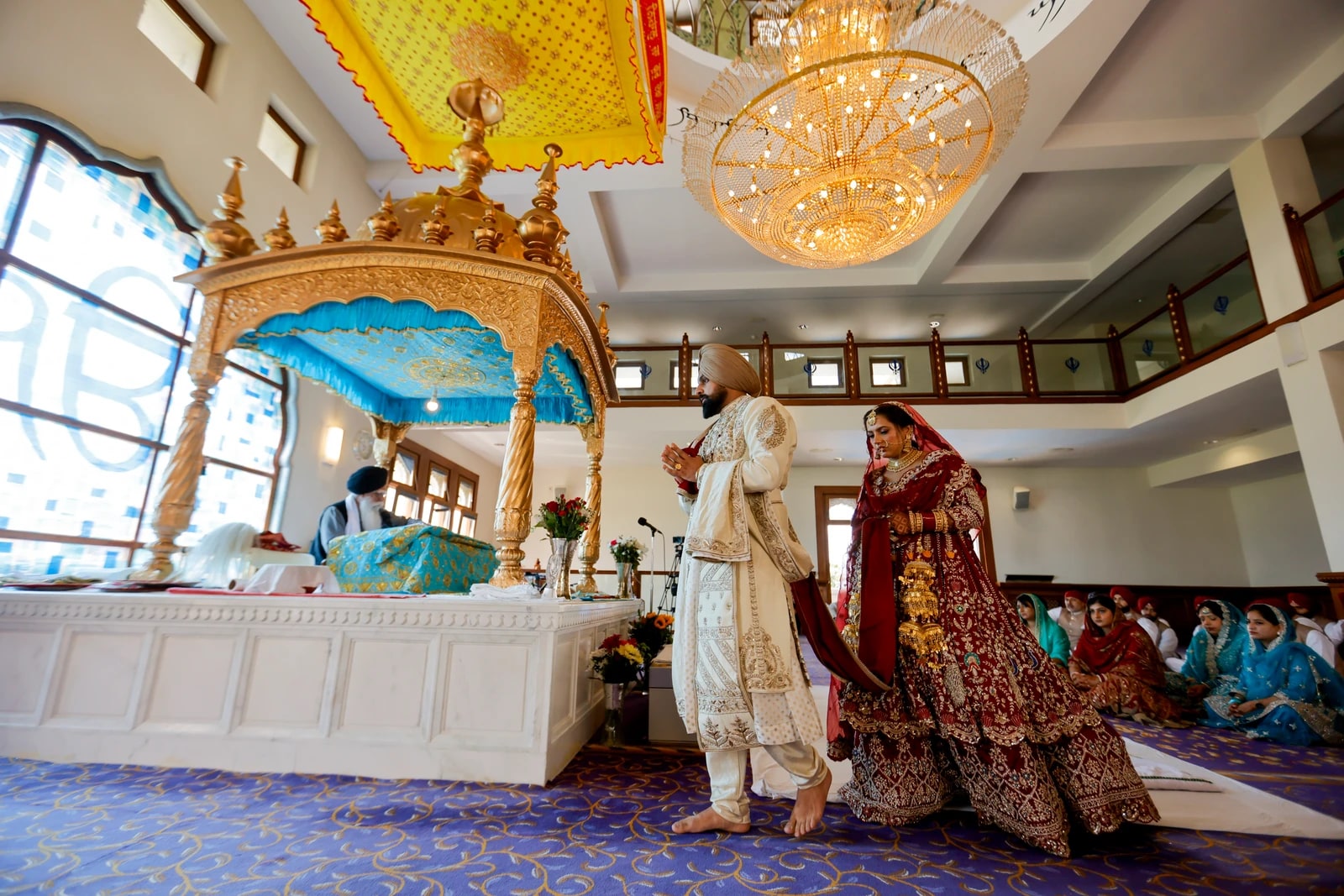
The Anand Karaj is the Sikh marriage ceremony. The couple sit before the Guru Granth Sahib and an Ardas is said. The bride's father, or a close relative, places one end of the groom's scarf, the palla, in her hand. Then the four Laavan are read and sung. During each one the couple walk clockwise around the Guru Granth Sahib, the groom leading and the bride following with the palla. After the fourth round the ceremony closes with Anand Sahib, a final Ardas, the Hukamnama and the sharing of Karah Prashad.
Every gurdwara has its own rules. Expect everyone, the crew included, to cover their heads and take off their shoes. Many gurdwaras also decide where cameras can stand, whether extra lighting is allowed, and whether anyone may stand between the congregation and the Guru Granth Sahib. Check with the gurdwara committee or the granthi before the day, and pass their answers on to your videographer. Our Sikh wedding ceremony page has more on the order of the day.
Where the cameras go
We keep our footprint small. Cameras sit low and to the side, so nobody crosses in front of the Guru Granth Sahib and the congregation can see. Usually one camera holds a wide view of the whole ceremony and another stays on the couple.
That second camera matters more than people expect. The couple's faces change through each of the four Laavan, and that is usually where the real emotion of the ceremony shows. A single wide shot cannot catch it.
Once the Laavan begin, we hardly move. Every movement in the darbar hall gets noticed, so we agree positions with the gurdwara beforehand and then stay put.
Recording the kirtan and the Laavan
Clear audio of the Laavan is the most important thing in a Sikh wedding film. The ragis and the granthi usually have their own microphones, and how we record depends on the gurdwara. Some are happy for a small recorder near their speakers or a feed from the sound system. Others would rather have nothing extra near the front. We ask ahead, and we always run a backup recorder.
In the edit, the hymns set the pace. In Ramandeep and Karan's film we let the kirtan breathe instead of cutting on every beat, and we lean on long, held shots in our Sikh films generally, because the ceremony does not rush and the film should not either.
When the ceremony is not in a gurdwara
Some couples hold the Anand Karaj in a marquee or hall set up as a gurdwara, with the Guru Granth Sahib brought in with full respect. For Ramandeep and Karan, the gurdwara-style setup went up inside a marquee, and sightlines took real planning so the room felt like a sacred space rather than an event. Whether this is possible depends on your gurdwara and your family, so talk to them early.
After the fourth Laav
When the fourth round ends, the room changes within seconds. People stand, applaud and come forward with blessings. In Ramandeep and Karan's film that turn from stillness to celebration plays out as it happened, and we keep rolling through it for that reason.
Langar usually follows in the community kitchen. It is a different kind of footage, unposed, noisy and warm, and we often give it its own chapter in the film.
Filming the doli
What happens
The doli is the bride's farewell to her family. In many families it happens at the end of the reception, or back at the bride's family home, before she leaves with her husband. Customs vary by family and region. Some brides throw puffed rice or coins back over their shoulder, some families sing traditional songs, and in many the bride's brothers or cousins walk beside the car. It is often the most emotional moment of the day, for her parents most of all.
How we film it
The doli is easy to lose because it comes last, when everyone is tired and the venue may be clearing. We plan it into the running order and keep a camera free for it. If it happens at the family home, that means a move between locations, so tell us the timing and address early.
We film it simply: the bride with her parents, close shots of hands and faces, and the car pulling away. The light may be poor by then, especially in winter, so we plan for that and avoid anything that would interrupt the family.
Planning your Sikh wedding film
Whoever you book, a few things make a real difference.
- Tell your videographer which gurdwara you have booked, and pass on its rules about cameras, lighting and positions.
- Share the morning timings: when the baraat arrives, when the milni starts and when the Anand Karaj begins.
- Name the key relatives for the milni, so the crew knows who to look for.
- Ask the gurdwara about audio, and whether a recorder near the ragis or a feed from the sound system is allowed.
- Put the doli in the running order, with a time and a place.
- Decide what kind of film you want. A short highlights film tells the story of the day, and a longer film can keep all four Laavan in full. Many couples want both.
You can read more about how we work on our wedding videography page. Memory Filming has filmed weddings since 2000, including about 3,300 Asian ceremonies, and the approach above comes from that experience.
Questions couples ask
Can you film inside a gurdwara?
Usually, yes, but each gurdwara sets its own rules. Most ask the crew to cover their heads, remove their shoes and keep out of the space in front of the Guru Granth Sahib. Some limit lighting or camera positions, so check with the gurdwara committee before the day.
Will the camera crew get in the way during the Laavan?
They should not. We set our positions before the ceremony starts, keep cameras low and to the side, and move as little as possible once the Laavan begin.
Can our film include the full Laavan?
Yes. A highlights film usually uses parts of the ceremony set to the kirtan, while a longer film can keep the four Laavan in full. Tell us which you want when you book.
Do you film the doli if it happens at home?
We can. Let us know the time and address in advance, so it is built into the plan and the crew has time to move between locations.
Check your date
If you are planning a Sikh wedding, tell us your date and your events and we will let you know whether we are free and how we would film your milni, Anand Karaj and doli.