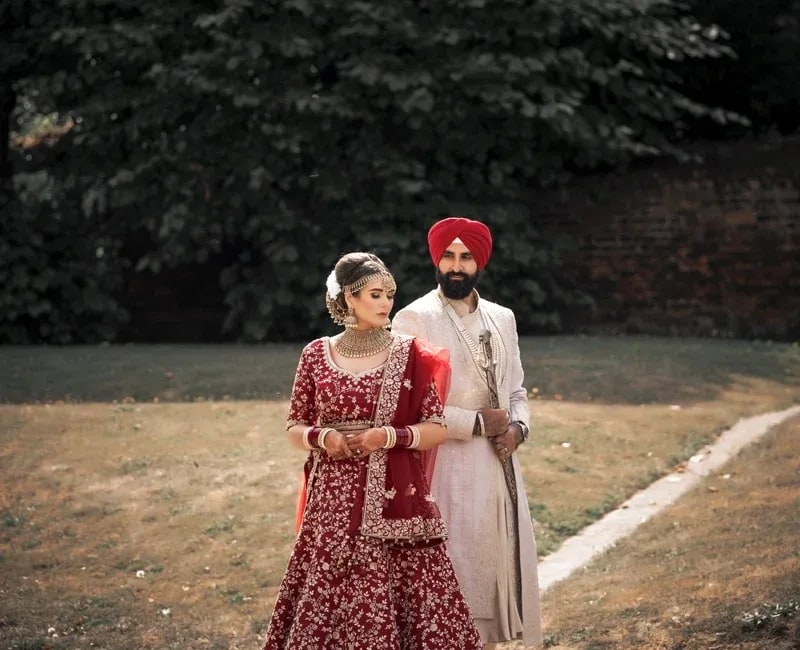
30 September 2026
← All writingA Roka is the ceremony in which both families agree to the couple's marriage is called a Roka, and typically involves the exchange of gifts or rings, as well as blessings by elders. One of the first pre-wedding events is usually small and only attended by the family, and in Punjabi & Sikh families they call it as Kurmai.
What is a Roka ceremony?
The formal occasion when the groom's and bride's families agree to the marriage is called the Roka, typically which takes place at the bride's or groom's home, with only close family members present.
The meaning of the word Roka is approximate 'to stop' or 'to fix', in the sense of 'to fix the match'. It can involve a tilak (placed on the groom's forehead by the bride's family), gifting or exchanging of sweets, and sometimes gifting or exchanging of the ring, which might be a separate event later in the engagement.
After the Roka, the couple is typically considered to be “promised” to each other and a wedding date is fixed.
Is Roka the same as Kurmai?
They're the same step, but they're known by different names in different regions. Roka is the more frequently used term in Hindi and North Indian families, whereas Kurmai is used more in Punjabi and Sikh families.
As there are a few variations in the customs of Kurmai, we have created a separate guide for it and will be including it in the Punjabi pre-wedding ceremonies post. Your family may use the term Kurmai, which is covered in more detail in that article. Wikipedia has a helpful overview of the Punjabi wedding traditions for background on how Roka fits in to the broader context.
What happens at a Roka ceremony?
This is more of a small, intimate family gathering, with gift-giving, blessings, and perhaps a meal shared, than a big spectacle.
A typical Roka involves the arrival of the groom's family with sweets and gifts, application of a tilak to the groom, exchange of rings or tokens between the couple, and blessings from elders in both families. The tone is typically relaxed and informal, rather than ritualistic, and then there's the food and conversation.
How should photography and videography be planned for a Roka?
A Roka is a day that is smaller in scale than a wedding day, so typically you will be able to capture a variety of candid, documentary style photos and a few family photos that are posed.
Others like having a fully documentary style in which there isn't any staged portraits at all, particularly if they are not feeling at ease being the centre of attention. It's a totally logical option and we're okay with it that way, stepping back and letting the day go as it will, instead of controlling it.
Other families would prefer the fuller traditional coverage: the tilak, the ring exchange, group photos with both families, and a short couple's portrait session out of the way of the chaos, just like we do with most pre-wedding shoots. In either case, it's helpful to let us know beforehand which direction you would like to go since it influences how much we are engaged or how much we step back.
Can Roka and engagement be combined into one event?
Yes, many modern families have done just that, especially if relatives are coming from overseas and a second trip to the other engagement is not an option.
If you have combined, please tell us and we can make plans for the family-agreement rituals, as well as your engagement time, like the ring exchange, in the same booking. For events like this, many couples add videography as well as photography as there is more going on over a longer period of time.
How far in advance should you book Roka coverage in London?
Rока dates are really not booked for a few months in advance, so when their date is confirmed book it immediately instead of waiting.
If you have multiple events, such as a pre-wedding, with your Roka, you may want to let them know, as pricing for multiple events during the wedding week may be better than pricing each one individually alone..
Roka Ceremony: Frequently Asked Questions
What's the difference between Roka and Kurmai?
They are both ceremonies, but the formal family agreement prior to marriage, with different names in different regions. The more common Hindi and North Indian term is roka while the Punjabi and Sikh term is kurmai.
Does the Roka include a ring exchange?
Sometimes. For some families, the Roka rings are exchanged during the ceremony itself, while for others, it is reserved for an engagement ceremony. It's different from family to family and has no single rule.
Can we choose documentary-only coverage with no posed photos?
Yes. If you would prefer not to have staged portraits, we can take the whole day in a more natural style, and just do a couple's picture if you would like one towards the end of the day.
How many hours of coverage does a Roka usually need?
It typically takes two to three hours, as most Rokas aren't the same length as the wedding day, and it's usually a shorter, smaller event.
Do you photograph Roka ceremonies outside London?
Yes, we do go out on trips for Roka and pre-wedding events throughout the UK. Please contact us to let us know your venue and we'll verify.
How soon after the Roka is the wedding date usually set?
It depends on the family, may be decided during the Roka itself or in the next few weeks after discussion from both families.
Related Pages and Guides
- Our documentary wedding photography guide
- Our 18 month Asian wedding photography timeline
- Sikh wedding photographer London
- Hindu wedding photographer London
- Indian wedding photographer London
- Navjot and Jessica wedding film